Yuanqing Yao
1. Congratulations on winning the NY Product Design Awards! Can you introduce yourself and share about what inspired you to pursue design as a career?
Thank you — I’m truly honored!
I’m Yuanqing, a multidisciplinary designer and strategist with a focus on human-centered design and emerging technologies. I’ve always been fascinated by how people think, feel, and move through the world — and how design can shift those invisible emotional and behavioral patterns.
What pulled me into design was the realization that design is not just about aesthetics; it’s about creating experiences that move people. Growing up in dense urban environments, I noticed how easily we become disconnected from ourselves and from nature.
That awareness became a central theme in my work — using design to help people slow down, reconnect, and rediscover emotional balance in a fast city life.
2. What does being recognized in the NY Product Design Awards mean to you?
This award means a great deal to me because it recognizes a type of UX work that’s deeply human — work that blends emotion, AI, motion design, and environmental psychology. It affirms that digital products can do more than drive engagement; they can nurture self-awareness, well-being, and connection with the real world.
Professionally, it’s a signal that the industry is increasingly ready for emotionally intelligent, AI-augmented experiences. Personally, it motivates me to keep designing for emotional depth and long-term human impact.
3. How has this achievement impacted your career, team, or agency, and what opportunities has it brought so far?
Winning has opened new conversations with designers, technologists, and organizations exploring emotional AI and behavioral design. It has helped people see my work not just as “UX,” but as a holistic practice that blends research, psychology, and AI-driven interaction.
It also gave visibility to the importance of well-being within digital product design — an area I hope to continue advocating for across teams and future collaborations.
4. What role does experimentation play in your creative process? Can you share an example?
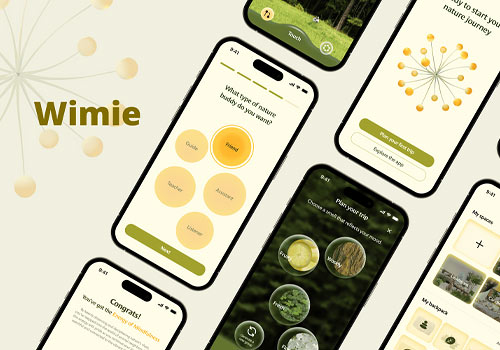
Experimentation is essential to my process, especially when designing with emerging technologies. For this project, our biggest experiments involved crafting emotion-driven motion behaviors for our AI companion — subtle head tilts, slow rhythmic breathing, and gentle bounces for excitement.
We prototyped dozens of micro-animations to test how each motion made users "feel" — calm, curious, supported, or overstimulated.
One memorable experiment was testing different tempo variations in the character’s “breathing.” A slower, grounded pulse unexpectedly helped users feel more relaxed, aligning their own emotional state with the bot’s energy. Those moments reminded me how small design decisions can carry profound emotional impact.
5. What's the most unusual source of inspiration you've ever drawn from for a project?
For this project, I drew a surprising amount of inspiration from plant behavior. Not flowers or leaves — but the "micro-movements" of plants responding to light, water, and touch. They’re subtle, slow, and deeply alive.
That insight shaped our AI companion’s personality: rooted in softness, groundedness, and calm responsiveness. Instead of designing a “smart assistant,” we designed a digital being that behaves more like a living organism than a device.
6. What’s one thing you wish more people understood about the design process?
That good design is rarely linear.
It’s not just wireframes → pixels → prototype; it’s research, reframing, intuition, doubt, testing, and rediscovery. Many of the best insights come from ambiguity — from asking why people behave the way they do, and from listening more than deciding.
Design is not just about solving problems; it’s about understanding people deeply enough that the solution becomes inevitable.
7. How do you navigate the balance between meeting client expectations and staying true to your ideas?
I approach it with alignment, not opposition.
Clients often express their needs in solutions — but underneath, there’s always a human truth they’re trying to reach. My role is to uncover that truth and reframe the conversation around shared goals.
When everyone aligns on the emotional and behavioral impact we want to create, the process becomes collaborative rather than compromising. Staying true to my design philosophy often leads to solutions that clients appreciate even more.
8. What were the challenges you faced while working on your award-winning design, and how did you overcome them?
One major challenge was ensuring the AI companion felt emotionally rich without overwhelming the user. We had to strike a careful balance between expressiveness and subtlety.
To overcome this, we conducted multiple rounds of user research in urban parks, at subway stations, and during short walking commutes. These insights helped us refine the motion language of the bot — adjusting tempo, gesture intensity, and color cues so that the experience supported mindfulness rather than competing with it.
Another challenge was translating emotional design principles into technically feasible interactions. Animation became our bridge — motion was the “voice” through which the AI expressed authenticity.
9. How do you recharge your creativity when you hit a creative block?
I go back to the physical world. Walking in nature resets me. Observing people in public spaces — how they wait, rush, gesture, pause — always gives me new ideas. I also sketch small moments or record motion references; paying attention to micro-gestures often unlocks new creative directions for digital interactions.
I’ve learned that creativity returns when I stop trying to force it and instead reconnect with sensory experiences.
10. What personal values or experiences do you infuse into your designs?
I bring a strong belief in emotional authenticity and human connection into my work. Growing up in busy cities, I’ve seen how easily people become disconnected from themselves, their bodies, and the natural environment. That lived experience shapes my approach: I design to slow people down, encourage reflection, and create digital interactions that feel safe, soft, and grounding.
I design with the conviction that technology should honor human emotion, not flatten it.
11. What is an advice that you would you give to aspiring designers aiming for success?
Be endlessly curious — about people, systems, emotions, and behaviors.
Learn to observe more deeply than you draw.
Design beyond the interface; design the moment, the emotion, the intention behind it.
And don’t rush to have a distinct “style.” Let your worldview form your voice. The most compelling work comes from designers who design from a place of clarity, empathy, and lived experience.
12. If you could collaborate with any designer, past or present, who would it be and why?
I would love to collaborate with Neri Oxman, whose work bridges biology, material ecology, and computational design. Her practice reimagines design as something symbiotic with the natural world — a philosophy that deeply resonates with my own interest in blending technology with emotional and environmental well-being.
13. What's one question you wish people would ask you about your work, and what's your answer?
Because emotion shapes behavior more powerfully than logic.
If we want healthier habits, deeper connection, and more mindful living — we must design experiences that speak to people’s emotional lives, not just their functional needs.