
Interface & User Experience
FridgeStreet AI
Entrant: VelvetY LLC
2026
Silver
A closer look
Project gallery.
Select a thumbnail to browse. Click the main image to enlarge.
CategoryInterface & User Experience
Class / SubcategoryUser Experience (UX)
Product UX
Product UX
Country / Region United States
Food to share. A community to care.
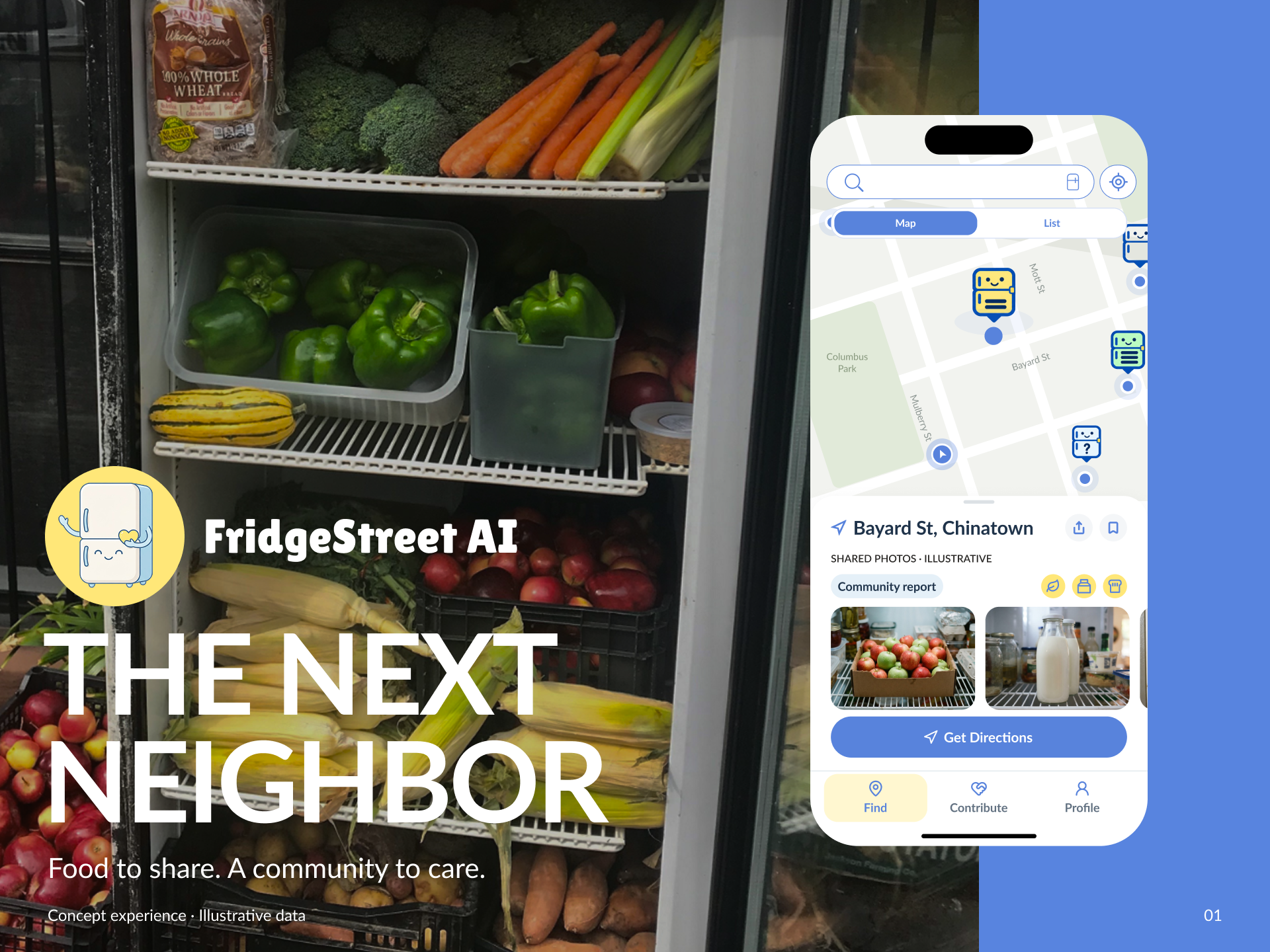
Community fridges have already created places where neighbors can share food freely. Yet food moves quickly, while information often struggles to keep up. Knowing where a fridge is does not always mean knowing what is available, when it was last checked, or whether the information can be trusted.
FridgeStreet AI reimagines how communities discover, update, and share food information. Rather than building new food-sharing infrastructure, it focuses on helping people make better use of what already exists.
Through an intuitive map, neighbors can locate community fridges, explore shared food photos, understand information sources, and find directions without needing to register or prove their need.
The defining innovation happens when someone arrives at a fridge.
A gentle, optional invitation asks: “A quick photo could help the next neighbor.”
With FridgeVision, AI-assisted image recognition proposes visible food items from a photograph. Users can review, correct, or confirm the suggestions before submitting a community report. Human judgment remains central: community reports are clearly distinguished from separately authorized inventory checks, and photographs are never treated as proof of food safety.
This experience creates the Community Relay—a simple cycle in which one neighbor finds food, voluntarily contributes information, and helps make the next person's visit more informed.
By introducing participation at the moment it is most convenient, FridgeStreet aims to make community updates easier, reduce repetitive reporting effort, and encourage small acts of collective care without placing obligations on those seeking food.
Presented as a human-centered concept prototype, FridgeStreet AI explores how thoughtful interaction design and responsible AI can strengthen existing community food-sharing networks.
**Food to share. A community to care.**
Explore the project.
Project credits.
Sihang Yang
Product Designer
Xuan Tang
UX Designer
Linhao Luo
UX Designer
Keep exploring
More winning perspectives.
2026 Silver Winner
Padded Half-Finger Training Gloves
Wuhan You Wen You Lu E-commerce Co., Ltd2026 Silver Winner
JIAO YANG 2
Li Ning Company Limited2026 Silver Winner
ArtFit
Polyzone Studio LLCYour work belongs in the conversation.
Begin Your Entry