
2026 Silver Winner
Conceptual
KIN – AI Companion for Alzheimer's Care
Entrant: Shahab Askarian
2026
Silver
A closer look
Project gallery.
Select a thumbnail to browse. Click the main image to enlarge.
CategoryConceptual
Class / SubcategoryMedical / Scientific Equipment
Healthcare
Healthcare
Country / Region United States
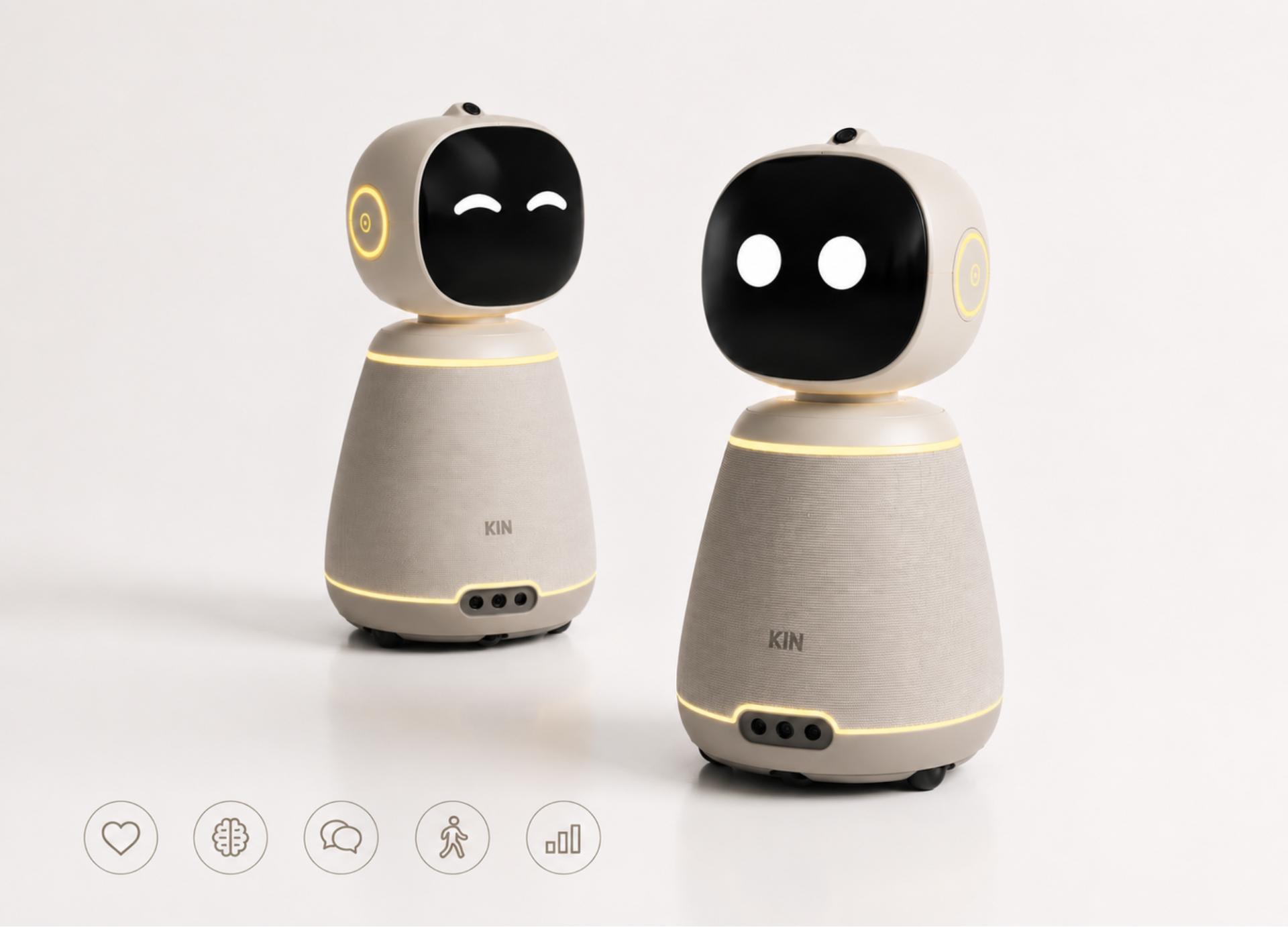
KIN is an AI companion robot designed to support older adults through conversation, reminiscence, cognitive stimulation, and gentle physical activity. WHO estimates that 57 million people were living with dementia globally in 2021, with nearly 10 million new cases annually, highlighting the need for accessible everyday support.
Its rounded ivory shell, textile-covered body, expressive digital eyes, and warm illuminated accents create an approachable alternative to clinical equipment. A compact wheeled base enables mobility, while a dedicated charging dock and visible battery indicators simplify daily operation. The design combines a friendly physical presence with a connected mobile application.
Personalized conversations draw on photographs, familiar music, family relationships, and meaningful life events to encourage storytelling and recall. Social challenges, such as calling a relative, promote contact beyond the robot, with progress rewards intended to encourage participation. These interactions aim to support emotional engagement and continuity of personal identity.
An integrated projection system presents memory games, walking paths, and guided movement activities on surrounding surfaces. Matching symbols, recalling sequences, exploring words, and solving simple problems engage different cognitive abilities. Movement prompts combine mental participation with physical activity, with difficulty intended to match individual capabilities.
KIN learns from interaction history and task performance to adapt subsequent exercises. The accompanying application organizes activity plans and monthly summaries across memory, attention, language, orientation, and problem solving. These records could help families notice changes and discuss concerns with healthcare professionals; they should not be interpreted as validated diagnostic assessments.
Explore the project.
Keep exploring
More winning perspectives.
2026 Silver Winner
LEZENER waterproof backpack
Guangzhou Lizheng Bags & Garments Co., Ltd.2026 Silver Winner
NICEMAY Microcurrent Ems Pro+ Multilift Device
Shenzhen Qianhai Nicemay Medical Beauty Instruments Co., Ltd.Your work belongs in the conversation.
Begin Your Entry