
2026 Silver Winner
Interface & User Experience
Memory Tree - Ginkgolink
Entrant: Shirui Wang
2026
Silver
A closer look
Project gallery.
Select a thumbnail to browse. Click the main image to enlarge.
CategoryInterface & User Experience
Class / SubcategoryUser Experience (UX)
Student Design
Student Design
Country / Region China
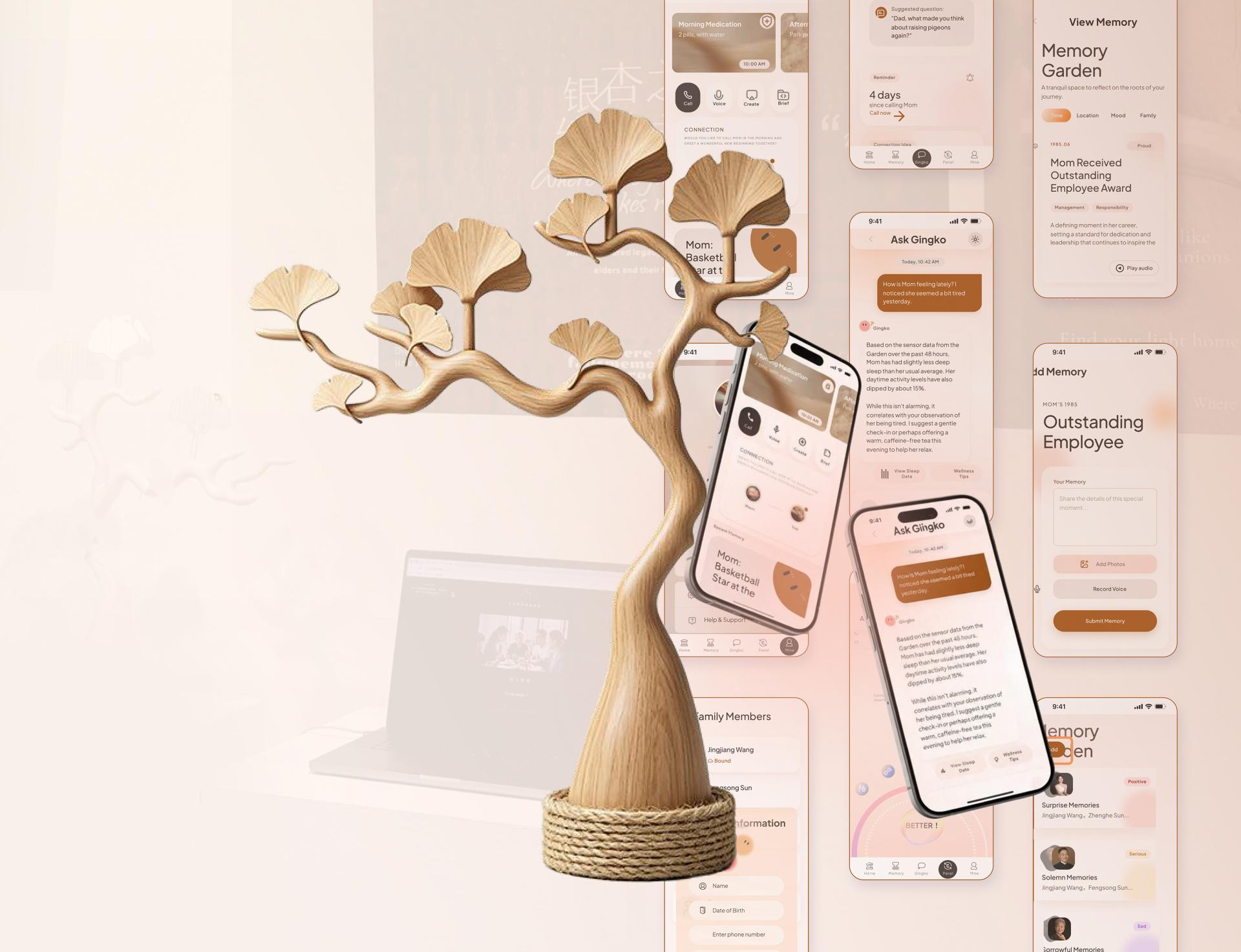
ChinaWith voice as an entry point and AI as a bridge, Ginkgolink is an intergenerational memory-interaction system that records older people's daily lives and reconnects families. Older people rely heavily on short videos and TV shows to ease loneliness, while families communicate less with each other. Ginkgolink helps them share their daily stories, voices, and memories effortlessly via a voice device with no complex operations. AI converts the content into text, images, and other shareable formats and then delivers them to families, making every share a starting point for family conversations.
The redesign of memory-record approaches is the core innovation. Traditional digital records require active photo-taking, input, and organisation, while Ginkgolink integrates recording into older people's daily expressions, lowering use barriers through low-threshold voice collection. AI not only transcribes memories, but also generates conversation prompts based on a deeper understanding of content, creating a continuous loop of "sharing-understanding-connecting". As content accumulates, scattered moments of life can form retainable, traceable family memories.
Inspired by ginkgo trees, the design integrates the organic forms of natural ginkgo leaves into the product shape, as well as the "memory tree" concept, symbolizing that memories grow over time through family interactions. The app interface uses warm beige and low-saturation orange, pink, and purple, combined with large rounded cards and enough white space to reduce visual burden. Together, the memory garden, AI dialogue, and family dashboard form a complete experience, ranging from recording and sharing to interaction.
Ginkgolink not only stores older people's memories but also integrates past experiences into current family relationships. It lowers the threshold for converting and organising memories through AI while making older people's past lives visible, building a new bridge for younger people to understand older people and to continue family memories.
Project credits.
Shirui Wang
Keep exploring
More winning perspectives.
2026 Silver Winner
Smartwash AI
Hangzhou Xinshuo Technology Co., Ltd.2026 Silver Winner
ArtiVanta
Suzhou Mikae Elevator Co., Ltd.Your work belongs in the conversation.
Begin Your Entry