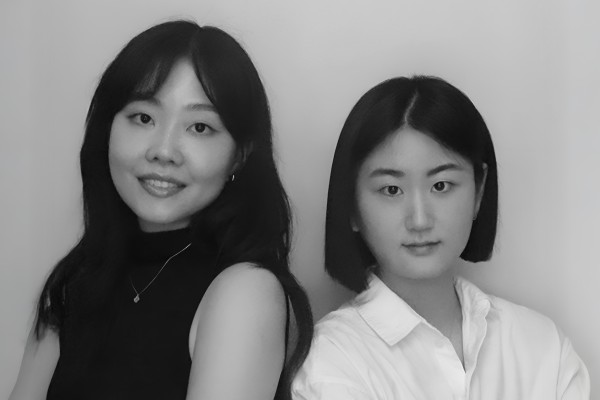
Sunwoo Park and June Jeongeun Park
1. Congratulations on winning the NY Product Design Awards! Can you introduce yourself and share about what inspired you to pursue design as a career?
Sunwoo: Thank you. I'm Sunwoo, a product designer who created Get Set NYC. I worked as a translator for Korea's railway system before working as a product designer. That experience made one thing clear: when information lacks structure, even simple tasks become overwhelming.
And that experience led me to start my journey as a product designer. The mindset I had while working as a translator still shapes how I design. People I've worked with say I make the problem space explicit before anyone designs anything.
June (Jeongeun): Thank you so much. This is a real honor. I'm June Jeongeun Park, and as a motion designer, I love bringing digital experiences to life with movement. After studying Computer Arts and Animation at SVA, I first worked as a VFX Compositor in film and advertising. I found myself fascinated by how even the simplest graphic could feel alive as soon as it started to move. That idea of giving a dynamic story to something static is the core of my work.
2. What does being recognized in the NY Product Design Awards mean to you?
Sunwoo: It means more than I expected. Design is often invisible when it works, and recognition like this is a rare moment where someone outside the project says: these choices were intentional, and they mattered. For Get Set NYC, the hardest decisions were about restraint, about what not to show. Winning in a Product UX category, where the jury evaluates reasoning rather than just visuals, validates exactly the kind of thinking I care most about.
June (Jeongeun): To be honest, this award feels incredibly personal. This project was one of my very first after I pivoted from VFX to motion design. After making a big leap like that, you carry a bit of self-doubt. More than anything, this award has given me a clear way to define what I do. This achievement has become the first real milestone that lets me confidently introduce myself as a motion designer.
3. How has this achievement impacted your career, team, or agency, and what opportunities has it brought so far?
Sunwoo: It has opened conversations that would have taken much longer to start otherwise. An award shifts things from 'tell me what you do' to 'tell me how you think.' Working with June was also formative. Our instincts were genuinely different; mine lean toward systems, hers toward rhythm. Seeing how those approaches combined into something stronger than either of us would have made alone changed how I think about collaboration.
June (Jeongeun): The most immediate impact has been a fundamental change in my professional visibility. This award acts as a powerful signal in a field of many talented professionals. Before, when I would suggest adding motion to enrich the experience, it was sometimes treated as a nice-to-have. But now, my ideas are met with an added layer of trust that comes from this recognition.
4. What role does experimentation play in your creative process? Can you share an example?
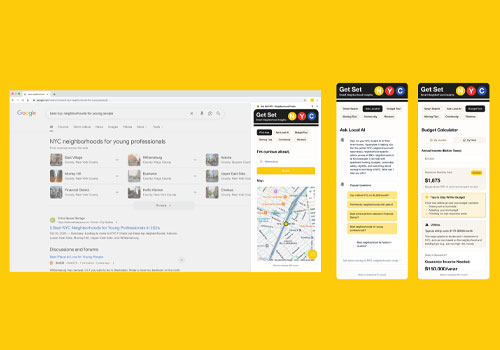
Sunwoo: Experimentation is huge for me. It’s really the only way to figure out what actually works for people. In Get Set NYC, the safety visualization went through three totally different versions. I started with a raw number—"30 incidents"—but that just made people feel anxious.
Then we tried a bar chart, but that led to confusing comparisons. I finally landed on a donut chart with a breakdown tooltip. Those iterations were essential because they moved us past what looked good to what actually helped users make better choices.
June (Jeongeun): For me, experimentation is testing different hypotheses until you find the most effective way to tell a story. A good example is the promo video for Get Set NYC. My biggest challenge was grabbing attention in the first three seconds.
Our breakthrough was showing the chaos visually: interfaces of Zillow, StreetEasy and Reddit rapidly changing, then resolving into the clean Get Set NYC logo. That gave us our core story, 'From Chaos to Clarity.' Once the story is set, experimentation finds the right stage direction.
5. What's the most unusual source of inspiration you've ever drawn from for a project?
Sunwoo: That would absolutely be my own experience moving to New York. It wasn't just about finding an apartment; it was about trying to understand a new neighborhood and figure out if it was actually safe and reliable, which was incredibly hard to do without getting taken advantage of. I actually got scammed out of $2,000 during one of my two moves, too.
When I talked to other people new to the city, everyone had similar, frustrating patterns. The core issue wasn't a lack of raw data; people weren't missing data. They were missing a way to interpret it. That really rough experience became the emotional and foundational core of what I built with Get Set NYC.
June (Jeongeun): My biggest source of inspiration was conversations with my friends. Most of them are immigrants, like me, who moved to New York. We often talk about the struggles of settling in and those moments when we finally figure something out. That experience became my core goal for the motion design: to capture the very human feeling of moving from a fog of information into a moment of relief and clarity.
6. What’s one thing you wish more people understood about the design process?
Sunwoo: That the most important design work is invisible in the final product, people experience fluency: things that make sense, information that lands at the right moment. What they don't see is the research, the discarded versions, the decision to cut a feature that was technically possible but cognitively expensive. Teams that skip this invisible work ship products that look polished but erode trust the moment they're used.
June (Jeongeun): That motion isn't just pretty decoration; it's like a product's facial expression or tone of voice. Take a delete pop-up: if it just appears, it's mechanical. But if it fades in gently, it feels like it's cautiously asking, 'Are you sure?' That small difference gives the user psychological safety. My job is to design those emotions. It's not just movement; it's the invisible conversation happening between the product and the user.
7. How do you navigate the balance between meeting client expectations and staying true to your ideas?
Sunwoo: I think of it as an alignment problem, not a balance problem. When there's tension, I first ask whether we're disagreeing about the solution or the problem. Those need different responses. If it's the problem, I'll go back to research. If it's the solution, I frame it in terms of specific trade-offs. My ideas are hypotheses. Strong pushback is usually a signal to pressure-test them, not defend them.
June (Jeongeun): In that situation, I intentionally try to set aside both my perspective and the client's. Instead, I put a third perspective at the center: the user's. Tension usually arises because it becomes a clash of tastes. When that happens, I completely shift the focus. It's no longer 'Who is right?' but 'What is the user feeling in this exact moment?' Once you do that, the debate disappears. Both the client and I are ultimately working for the user.
8. What were the challenges you faced while working on your award-winning design, and how did you overcome them?
Sunwoo: The hardest challenge was presenting sensitive data without amplifying fear. Raw crime statistics increased anxiety without improving understanding. Also, there was a technical failure: my design triggered 126 API calls per load, causing a ten-second delay. I reviewed with an engineer and reduced that to four calls. Load time dropped under three seconds. Backend performance is a UX decision.
June (Jeongeun): The biggest challenge was capturing the soul of the product in 30 seconds. Our first attempt was a chaotic instruction manual, not a story. I realized we had to focus less on the features and more on the why: turning the overwhelming feeling of moving into a feeling of confidence. Once that emotional journey became our story, deciding which features to show was simply casting the right actors to tell it.
9. How do you recharge your creativity when you hit a creative block?
Sunwoo: I'll leave the screen for a while. When you take too much time on a single task, your vision becomes narrow, and you can’t see what is different and what can be improved. Walking away from the project and reaching out to colleagues for new perspectives work really well when I need to recharge my creativity. Explaining the block out loud also helps. Halfway through, I usually find the answer and can go back to work.
June (Jeongeun): I'm pretty much the same as Sunwoo. The first thing I do is step away from my computer. When you're too focused on a problem, you can't see the answer. When that happens, I just try to stop thinking about design and do something completely unrelated. After I've cleared my head, the solution that was invisible yesterday suddenly seems obvious when I come back. It's not a special technique. It's just about creating a little distance.
10. What personal values or experiences do you infuse into your designs?
Sunwoo: Trust and access. I've experienced what it feels like to use systems that don't account for people like you, platforms that assume prior knowledge or language fluency that excludes users outside the default.
June (Jeongeun): My most important value is 'Motion as Navigation.' Digital spaces can be disorienting. When screens abruptly change, users get lost. My role is to be their guide. Instead of just changing the screen, I use motion to show the relationship between a user's action and the result. For example, an item in a list expands into its detail page. This movement silently tells the user: you are here now. That's the value I care about most.
11. What is an advice that you would you give to aspiring designers aiming for success?
Sunwoo: Build something real by yourself! Not a mock-up or a case study, but an actual product that exists in the world, that someone uses, that you're responsible for when things go wrong. Shipping something real from 0 to 1 shows you your blind spots. You find out which parts of the process you've been skipping, and you will get to understand how engineers, PM, and other stakeholders think when building a product.
June (Jeongeun): My advice is to develop your own taste. Skills are fundamental, but what makes you irreplaceable is not just skill, but how you use it to express your unique point of view. Good design solves a problem, but great design is born when the designer's unique voice is added to it. If skill is your hand, then taste is your voice. Train your hand, but don't forget to find your voice.
12. If you could collaborate with any designer, past or present, who would it be and why?
Sunwoo: Giorgia Lupi, without hesitation. She built an entire philosophy around Data Humanism: the idea that data is not abstract, it's deeply personal, and design's job is to surface that humanity. What I admire most is that she treats data as a way to find ourselves, not just analyze the world. Working with her would push me to ask not just "is this clear?" but "does this actually feel true?"
June (Jeongeun): I would love to collaborate with the sculptor Alexander Calder. When I look at his work, so many pieces evoke a sense of imagined movement. Even his completely still 'Stabile' sculptures feel as if they were frozen mid-motion. He is the master of 'potential for movement' and 'perfect balance.' His mobiles create a living harmony with no mechanical force, relying only on balance and air currents. That philosophy deeply resonates with how I think about motion.
13. What's one question you wish people would ask you about your work, and what's your answer?
Sunwoo: I wish people would ask: what did you get wrong? Design conversations tend to celebrate the final product, but the real craft lives in the failures nobody talks about. Some of my most important decisions came from things that quietly fell apart during testing, moments that forced me to rethink something I was certain about. That process of being wrong and finding your way through it is honestly where the most interesting work happens.
June (Jeongeun): I wish people would ask: 'What does your graph editor usually look like?' My default curve is never a generic ease-in-out. It starts gently, accelerates with confidence, then comes to a long, reassuring stop. The gentle start is respect. The confident acceleration is efficiency. But the long, reassuring stop is the most important part: like an airplane landing smoothly, it tells the user, 'You've arrived safely. It's okay.' Every core interaction I work on is a variation of this single curve.