Chenglin (Clover) Li
1. Congratulations on winning the NY Product Design Awards! Can you introduce yourself and share about what inspired you to pursue design as a career?
My name is Chenglin (Clover) Li. I am a designer, computational artist, and entrepreneur whose work explores how emerging technologies can be transformed into meaningful human experiences. I hold degrees from New York University and the University of California, Berkeley. My work has received international recognition through projects such as OceanLung, Breezy, and MELTING.
2. What does being recognized in the NY Product Design Awards mean to you?
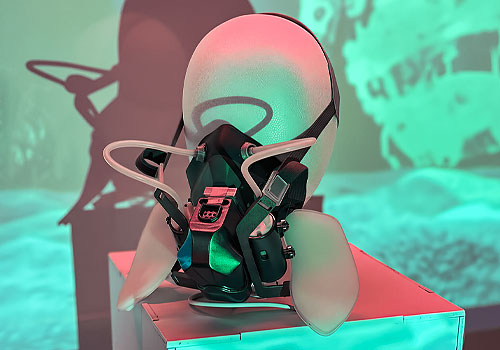
This recognition is especially meaningful because OceanLung was developed as an exploration of how design can make invisible environmental challenges tangible and personal. The project transforms scientific data on ocean deoxygenation into a physical breathing experience, enabling people to empathize with marine ecosystems affected by oxygen loss.
The NY Product Design Awards are particularly meaningful because they validate the impact of interdisciplinary design approaches that bring together technology, sustainability, engineering, and storytelling to communicate complex environmental issues.
3. How has this achievement impacted your career, team, or agency, and what opportunities has it brought so far?
The award has increased the visibility of my work and created opportunities to connect with designers, researchers, engineers, and innovators worldwide. It has reinforced the value of using interdisciplinary design to address challenges across sustainability, healthcare, and emerging technology.
Through projects such as OceanLung, Breezy, and MELTING, I have explored how complex systems can be translated into experiences that people can better understand and engage with. It has opened new avenues to collaborate with institutions, industry leaders, and interdisciplinary professionals across multiple sectors.
4. What role does experimentation play in your creative process? Can you share an example?
Experimentation is central to my practice because many of the challenges I explore have no predetermined solutions. I use iterative prototyping to test ideas, refine interactions, and uncover new possibilities.
OceanLung exemplifies this approach. Rather than simply visualizing environmental data, I developed a wearable system that translates ocean deoxygenation into a physical breathing experience. By integrating pneumatic systems, embedded technology, and user-centered design, the project creates a direct sensory connection between human breathing and marine ecosystem health.
Although OceanLung address different challenges, it explores how breathing can become a meaningful interface that encourages awareness, engagement, and behavioral change.
5. What's the most unusual source of inspiration you've ever drawn from for a project?
One unusual source of inspiration is breathing itself. We rarely notice it until it becomes difficult, yet it influences both human health and environmental systems. This idea inspired OceanLung, which explores ocean deoxygenation through a physical breathing experience and investigates how breathing can become a medium for awareness, healing, and connection.
6. What’s one thing you wish more people understood about the design process?
I wish more people understood that design is about problem-solving, not just aesthetics. Effective solutions require research, systems thinking, testing, and empathy, while the final outcome reflects only a small part of the overall process.
7. How do you navigate the balance between meeting client expectations and staying true to your ideas?
I view design as a collaborative process that balances stakeholder goals, technological capabilities, and human needs. The most successful projects create long-term value by aligning all three.
8. What were the challenges you faced while working on your award-winning design, and how did you overcome them?
One of the greatest challenges in my work is designing systems that help people better understand, interact with, and respond to complex challenges.
In OceanLung, I transformed the abstract issue of environmental change into a physical experience by using breathing as a medium for understanding ecological systems.
9. How do you recharge your creativity when you hit a creative block?
I often step outside my discipline and explore unfamiliar fields such as biology, environmental science, engineering, and architecture. New perspectives help me discover unexpected connections that often lead to fresh ideas.
For example, my projects, OceanLung and Breezy, both use breathing as a design medium, yet they address entirely different challenges. OceanLung explores environmental awareness through ocean deoxygenation, while Breezy supports respiratory recovery for children through interactive therapy experiences. Similarly, MELTING explores transformation through material behavior and textile engineering. Seeing how similar principles can be applied across different contexts often helps me develop new perspectives and ideas.
10. What personal values or experiences do you infuse into your designs?
Curiosity, empathy, and systems thinking consistently guide my work. Whether developing breathing-centered experiences such as OceanLung and Breezy, exploring material transformation through MELTING, or creating computational artworks, I am interested in how design can help people better understand complex systems through reflection, engagement, and direct experience.
11. What is an advice that you would you give to aspiring designers aiming for success?
Focus on learning how to think rather than simply learning tools. Technologies will continue to evolve, but the ability to solve problems, communicate ideas, and understand human needs remains essential.
My experiences working with organizations such as NOV and SLB have reinforced the value of interdisciplinary thinking, where some of the most impactful innovations emerge through collaboration between engineers, scientists, business leaders, and designers.
12. If you could collaborate with any designer, past or present, who would it be and why?
I would choose Aki Inomata. Her exploration of transformation, material behavior, and human-environment relationships closely aligns with my work in OceanLung, Breezy, and MELTING. I would be fascinated to explore how emerging technologies and responsive materials could further deepen those connections.
13. What's one question you wish people would ask you about your work, and what's your answer?
I wish more people would ask: “What experience are you designing to resonate with audiences?”
My answer is that many of my projects are not simply about creating objects or experiences. They are attempts to translate complex issues into forms that people can personally understand.
Whether I am creating breathing-centered experiences such as Breezy and OceanLung, developing the zero-waste fashion system MELTING, or designing digital solutions for organizations such as NOV and SLB, I am interested in helping people experience ideas rather than merely observe them.