Shirley Guo
1. Congratulations on winning the NY Product Design Awards! Can you introduce yourself and share about what inspired you to pursue design as a career?
My name is Shirley, and I am a designer working across design, product, and engineering. I was drawn to design because of its ability to meaningfully impact people’s everyday lives, whether through physical products or digital experiences, regardless of where they come from.
What inspires me most is the opportunity to understand people’s challenges and translate them into solutions that make their lives simpler, more intuitive, and more enjoyable. This connection between problem-solving and human impact is what continues to motivate me in my work.
2. What does being recognized in the NY Product Design Awards mean to you?
Being recognized in the NY Product Design Awards is both meaningful and encouraging. It validates the thinking and rationale behind my work and reinforces the importance of designing with clarity, intention, and a strong connection to user needs.
3. How has this achievement impacted your career, team, or agency, and what opportunities has it brought so far?
This recognition has strengthened my confidence as a designer and reinforced the impact of the work. It has also created opportunities for broader visibility within the design community.
4. What role does experimentation play in your creative process? Can you share an example?
Experimentation is a core part of my design process, as it allows me to quickly validate assumptions and understand how users respond to different ideas. Depending on the stage of the project, I explore multiple designs at different levels of fidelity, from low-fidelity sketches to high-fidelity interactive prototypes, to gather feedback early and often. This helps me identify friction points, refine flows, and iterate based on real user input rather than assumptions.
For example, in early product explorations, I often explored multiple interaction approaches before committing to a final direction, ensuring the solution evolves based on user behavior and feedback.
5. What's the most unusual source of inspiration you've ever drawn from for a project?
One of the most unexpected sources of inspiration for me has been judging hackathons and reviewing early-stage product ideas. By observing a large number of concepts in a short period of time, I started noticing patterns in why certain ideas fail to move beyond the concept stage.
It is often not due to execution, but because they solve problems that are unclear, unimportant, or lack grounding in real user behavior. Over time, I began developing my own way of evaluating ideas during this process, focusing on four dimensions: wow effect, functionality, usability, and storytelling.
These observations have directly influenced how I approach product design. Instead of starting with “what can we build,” I now focus more on whether something should exist in the first place, and whether it meaningfully connects to real user needs.
6. What’s one thing you wish more people understood about the design process?
I wish more people understood that design is fundamentally about people. While AI is rapidly transforming how we create, it doesn’t replace the human perspective behind meaningful design. Even with the same tools, different designers arrive at different outcomes, because design is shaped by judgment, empathy, and lived experience. Human designers bring emotional understanding and context that go beyond efficiency or optimization.
Ultimately, design isn’t just about producing interfaces. It’s about creating experiences that resonate with real people. That human connection is what makes a product meaningful and impactful.
7. How do you navigate the balance between meeting client expectations and staying true to your ideas?
Balancing client expectations with design perspective is a core part of the role. I approach it by first deeply understanding the client’s underlying goals and pain points. From there, I aim to align on outcomes rather than specific solutions. This creates space to introduce alternative ideas that may better address the problem while still meeting their expectations.
The process naturally involves ongoing communication and iteration, but I see that as a strength. Strong design isn’t about choosing between client needs and original ideas. It’s about reframing the problem so both can be achieved in a meaningful way.
8. What were the challenges you faced while working on your award-winning design, and how did you overcome them?
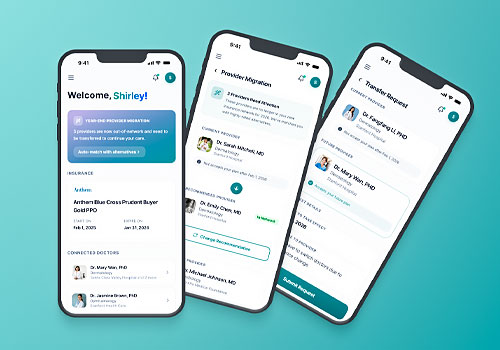
One of the main challenges during the design process was determining how to meaningfully integrate AI into a user flow that traditionally requires multiple steps, while ensuring users still felt in control of their decisions.
I knew I wanted to use AI to help users streamline the provider switching process, but I initially wasn’t sure how to introduce it in a way that felt helpful rather than overly automatic or restrictive. To address this, I explored multiple directions through user research, iterative prototyping, and design reviews.
This helped me better understand where AI could reduce friction without removing user agency. After several rounds of iteration, I arrived at a solution that uses AI to support the year-end provider change process due to an insurance update with a one-click experience, while still allowing users to review and make adjustments as needed.
9. How do you recharge your creativity when you hit a creative block?
When I hit a creative block, I intentionally step away and shift into a different environment, whether that’s a coffee shop, a library, or spending time in nature. Changing context helps me reset mentally and break out of the same patterns of thinking.
More importantly, it allows me to return to the problem with a fresh perspective. I often find that stepping away doesn’t slow progress. It actually helps me approach the same challenge from a new angle and uncover ideas that wouldn’t have surfaced otherwise.
10. What personal values or experiences do you infuse into your designs?
One of my core values in design is ensuring that every solution is grounded in real user needs and meaningful problem-solving. I always try to approach design from the perspective of the end user, not just in terms of usability, but in understanding their motivations, constraints, and behaviors.
Beyond empathy, I also place strong emphasis on intentionality, asking whether a product or feature should exist in the first place, and whether it meaningfully improves the user’s experience rather than adding unnecessary complexity. These values guide me to design with clarity, purpose, and a strong focus on real-world impact.
11. What is an advice that you would you give to aspiring designers aiming for success?
My advice evolves as I continue to learn, but one principle has stayed consistent: stay true to your perspective. Every designer brings a unique way of seeing and interpreting the world, and that point of view is what makes the work meaningful.
In today’s AI-driven landscape, where many outputs can feel similar and optimized, individuality becomes even more important. What differentiates designers is not just execution, but how they think, what they prioritize, and how they connect with people.
Develop your taste, trust your judgment, and let that guide your work.
12. If you could collaborate with any designer, past or present, who would it be and why?
I would choose Antoni Gaudí. I’ve always been inspired by his ability to translate imagination into highly distinctive, almost otherworldly forms while remaining deeply connected to nature and human experience. His work feels both unconventional and timeless. I had the opportunity to visit La Sagrada Família and Casa Batlló in Barcelona, and experiencing them in person made a lasting impression on me: the level of detail, symbolism, and emotional impact is remarkable.
It would be fascinating to collaborate with him and better understand how he balanced creativity, structure, and meaning in his work, and how those principles might translate into today’s design challenges.
13. What's one question you wish people would ask you about your work, and what's your answer?
Q: From your point of view, will AI eventually replace the designer role?
A: I don’t believe AI will replace designers, but it will significantly transform how we work. Tools like Figma Make and Claude Design have already helped designers work more efficiently by accelerating ideation, exploration, and iteration. However, they primarily optimize execution, not decision-making. What remains distinctly human in the design process is the ability to bring imperfection, emotion, and lived experience into decision-making. These elements are what give design its meaning and “soul,” which purely AI-generated outputs often lack.
Instead of viewing AI as a replacement, I see it as a tool that amplifies designers’ capabilities, allowing us to focus more on intention, problem framing, and creating meaningful user experiences.