
Interface & User Experience
Rippling
Entrant: Zilu He
2026
Gold
A closer look
Project gallery.
Select a thumbnail to browse. Click the main image to enlarge.
CategoryInterface & User Experience
Class / SubcategoryUser Interface (UI)
Interfaces for Digital Media
Interfaces for Digital Media
Country / Region United States
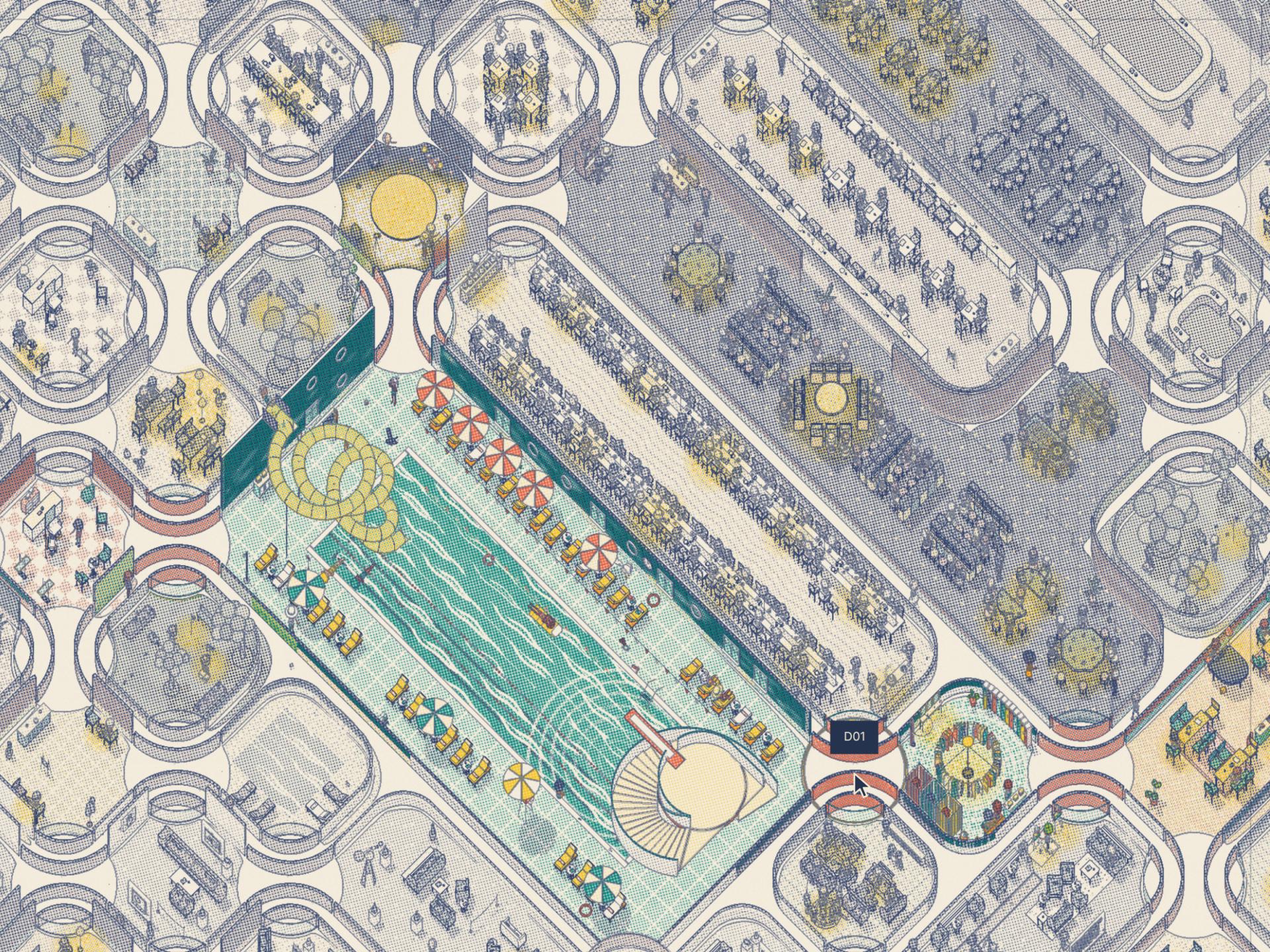
In Rippling, the building is the interface. Turning a story door at the right moment can change who meets whom. This browser-based interactive architectural film brings six protagonists and three interwoven storylines into a proposed building of 101 rooms and 67 revolving doors. Its design challenge is to make spatial cause and effect legible without interrupting the experience of watching a film.
A turn made before a door has affected the story recalculates subsequent events while preserving the past. In one sequence, a viewer’s intervention delays a visitor by two seconds, allowing a student to catch up with her before the elevator departs and preventing his painting from falling into the pool. The consequences unfold within the film, through movement, timing and encounters.
Viewers can watch the directed film, follow an individual or a pair, and pause to inspect the building. Six timeline lanes organize the overlapping lives. At key moments, relevant rooms retain their color while surrounding spaces recede into linework on tracing paper. Names appear selectively, and controls fade during uninterrupted playback, guiding attention between the unfolding scene and the wider building.
Each room is conceived as a story of its own, with everyday rituals unfolding alongside the protagonists’ journeys. Through shared spaces, sightlines and thresholds, these local lives become part of the film’s larger narrative.
Rendered in four inks, the living drawing offers 40 palettes and eight pen treatments. The layout adapts to desktop and phone screens. Keyboard controls support playback, timeline navigation, character selection and story-door interaction; reduced-motion camera behavior replaces glides with cuts.
Viewers read the story through space—and change it through the architecture itself.
Explore the project.
Project credits.
Mark Anderson
Thesis advisor, University of California, Berkeley
Raveevarn Choksombatchai
Thesis advisor, University of California, Berkeley
Keep exploring
More winning perspectives.
2026 Gold Winner
Lily Light Composition LC0545-1
Vargov Design2026 Gold Winner
Race 550ES
QJMOTOR2026 Gold Winner
DREAME AURORA LUX
DREAME AURORAYour work belongs in the conversation.
Begin Your Entry